
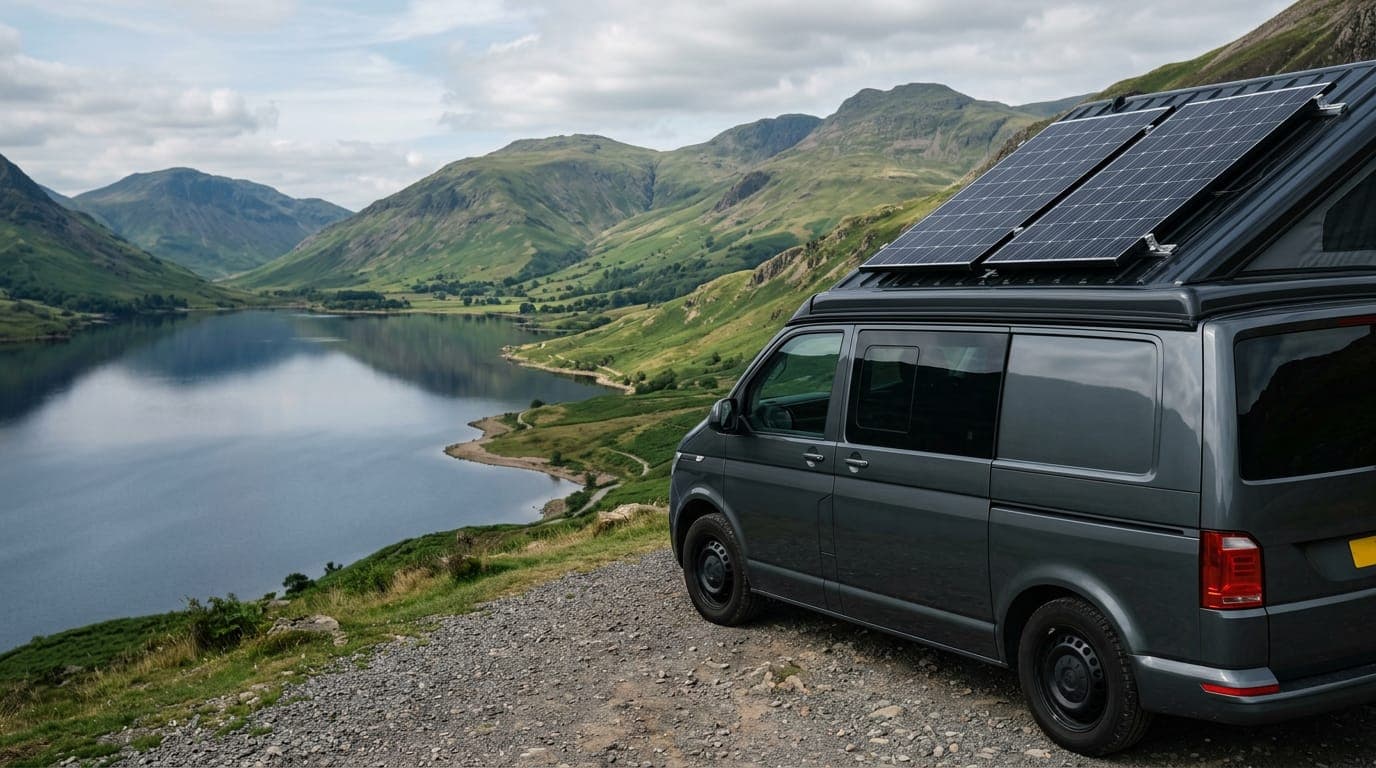
Solar Panels for Your Campervan
Do you need them?
Solar can help keep your leisure battery topped up, but the right setup depends on how you travel.
More freedom.
Power for the journey.
Campervan solar: the quick answer
Consider solar if…
you spend time away from electric hook-up and want to help keep your leisure battery topped up.
Choose your setup…
roof-mounted panels for convenience, or portable panels for flexibility when parked.
But…
solar output varies with weather, shade and season. Start with your power needs and battery capacity.
Which solar setup suits you?
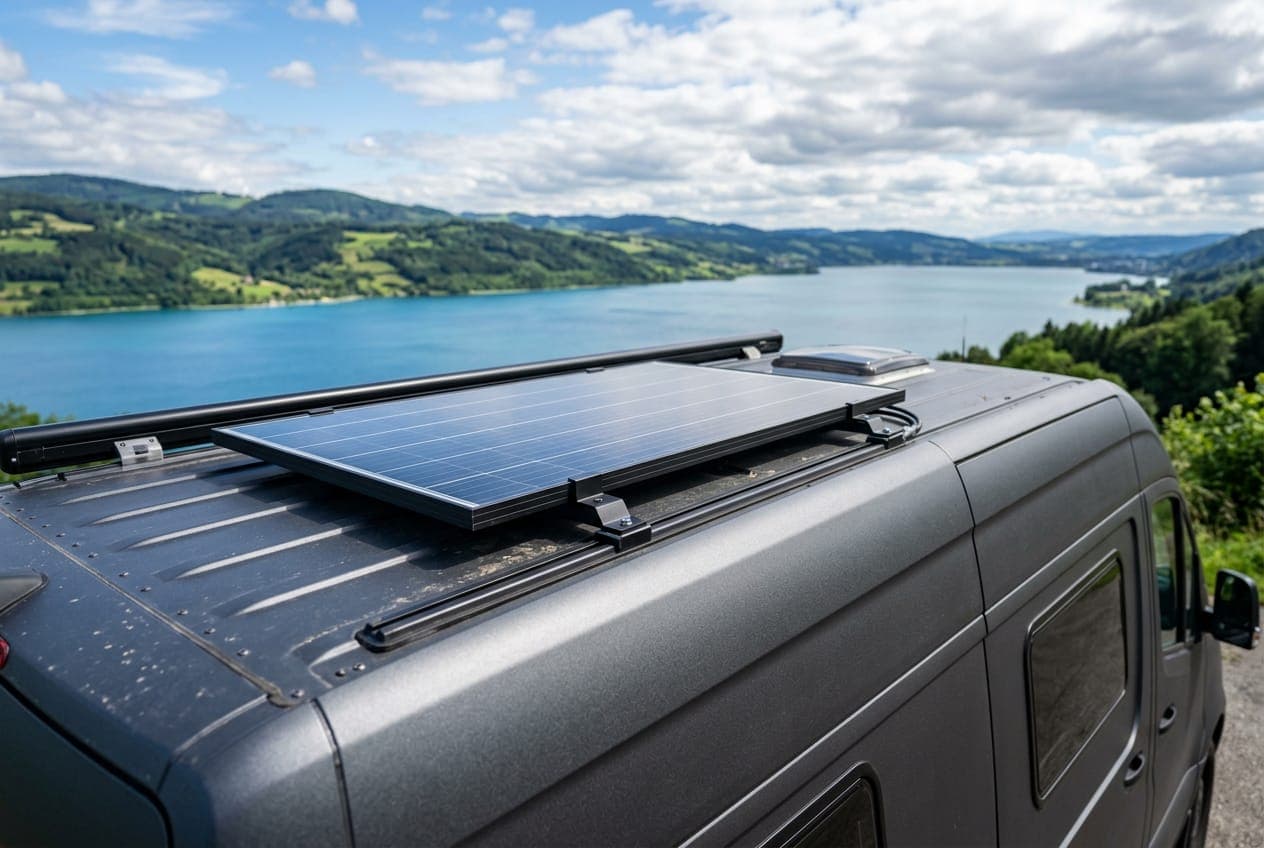
Roof-mounted solar
Always with you, ready to charge when conditions allow.
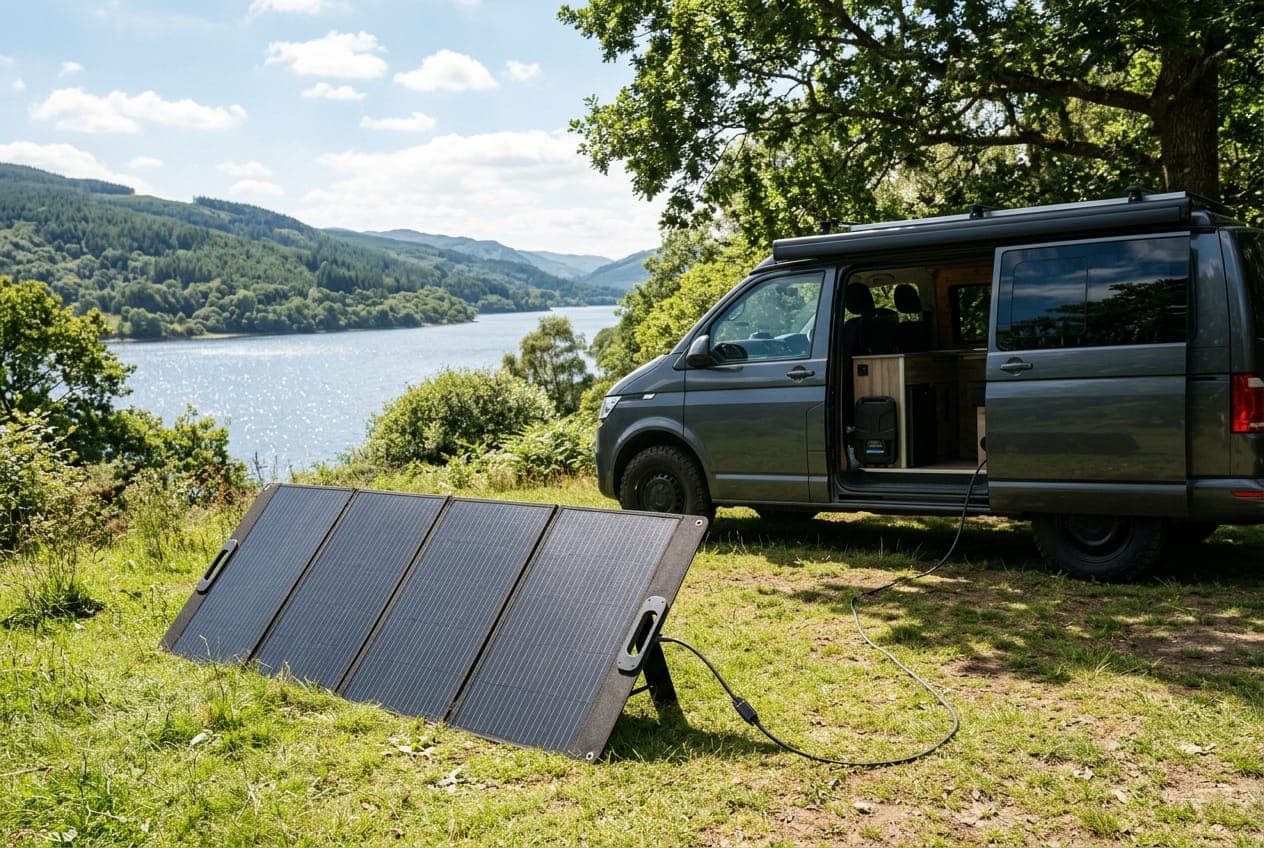
Portable solar
Position it in the sunshine while your van stays in the shade.
What might you use each day?
An illustrative daily budget for two people — not a measured average.
| Appliance | Example use | Energy |
|---|---|---|
| Compressor fridge | Over 24 hours | 300 Wh |
| LED lights | 10 W × 4 hours | 40 Wh |
| Two phones | One charge each | 40 Wh |
| Laptop | 50 W × 2 hours | 100 Wh |
| Water pump | Brief daily use | 20 Wh |
| Example total | 500 Wh/day | |
Your fridge is often the biggest everyday load. Hot weather, heating fans and extra devices can increase demand.
Illustrative assumptions. Check your appliances or measure actual use. Electric cooking, water heating and inverter losses are excluded.
W = power at a moment. Wh = energy used over time.
What can solar give you?
A panel's watt rating is a peak figure, not what it produces all day.
| Panel size | 2 peak sun hours | 4 peak sun hours |
|---|---|---|
| 100 W | 160 Wh/day | 320 Wh/day |
| 200 W | 320 Wh/day | 640 Wh/day |
| 300 W | 480 Wh/day | 960 Wh/day |
Illustrative calculation: panel watts × peak sun hours × 0.8. The 80% factor allows for assumed system losses.
Peak sun hours describe equivalent full-strength sunshine, not hours of daylight. These are scenarios, not UK seasonal forecasts.
Put that into perspective
Against the 500 Wh example, a 200 W panel gives about 640 Wh in the 4-hour scenario — but only 320 Wh in the 2-hour scenario.
Shade, cloud, roof angle and season can reduce output considerably. Solar charges your leisure battery: the battery supplies your appliances.
Method: Victron Energy solar-sizing guidance. Example assumptions shown.
Plan for the cloudy days too.
The pros and cons of campervan solar
Benefits
- Quietly tops up your leisure battery whenever there is daylight
- Extends how long you can stay away from electric hook-up
- No fuel, no noise and very little maintenance
- Reduces how often you need to drive just to recharge
Trade-offs
- Output drops sharply in winter, cloud and shade
- Roof panels add cost, weight and another fitting to check
- Portable panels need setting up, storing and securing
- It can't keep up with high-power loads like electric cooking
My experience
On a bright summer day, solar quietly does its job and you barely think about the battery. It's on grey, short days — or when you've tucked the van under trees for shade — that you notice how much the output drops.
The real benefit is peace of mind: knowing a few days parked up won't leave the fridge warm. It works best alongside charging while driving, not as a replacement for it.
The Campervan Considered view
Solar is a charging source, not an unlimited power supply.
If you mostly use campsites with hook-up, solar is a nice extra rather than a necessity. If you regularly stay off-grid for a few days in the brighter months, it's one of the most useful upgrades you can have.
Work out your daily use first, make sure the battery can cover a cloudy day or two, then size the solar to help refill it.
Watch or listen
Watch the solar discussion or listen to the podcast episode.
Solar episode — coming soon
Sources & specifications
Solar-sizing guidance, appliance specifications and the assumptions behind our examples.
- Victron Energy — MPPT solar charge controller calculator(opens in a new tab)
- European Commission JRC — PVGIS solar irradiation tool(opens in a new tab)
Appliance figures are typical examples. Check the rating plate or manufacturer specification for your own equipment.
Next guide
Solar is one part of your power setup. Next, think about how you store and manage that energy.
Choosing your leisure battery